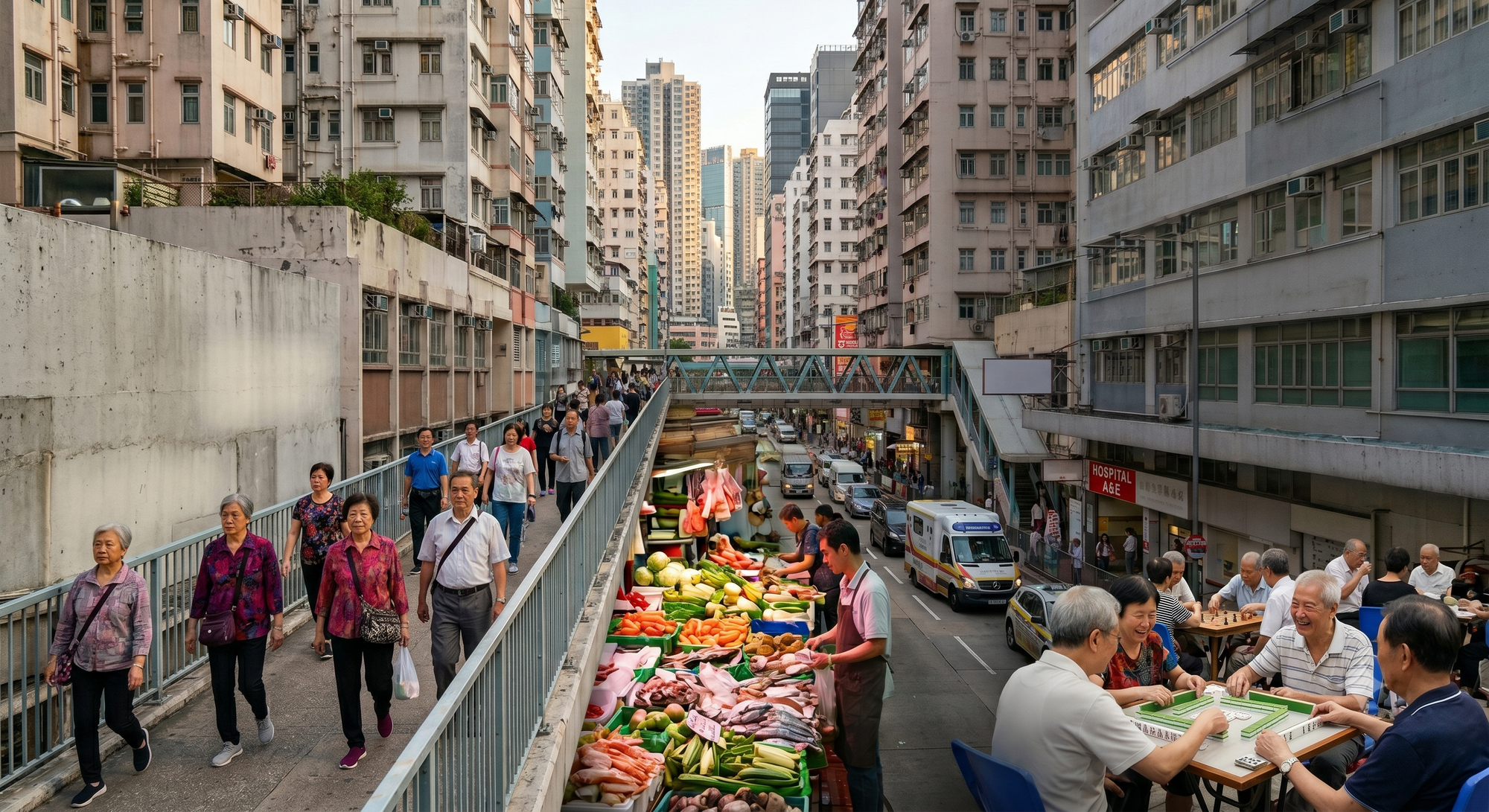
Hong Kong consistently ranks among the places with the longest-living people in the world (83 years for men and 88 years for women).
On the face of it, Hong Kong doesn’t seem to support this sort of life expectancy. It’s dense (Mongkok alone breaking world records at 130,000 people per square kilometre), noisy, polluted, and fast-paced. It has an intense working culture and, for many people, not much obvious room for leisure. On paper, you could easily write it off as a place that is bad for long-term wellbeing.
It got me thinking, how does a city that appears so demanding still produce such remarkable longevity? Going down a bit of a rabbit hole, I think is a mix of deliberate government policies, some actual good habits, and frankly some fluke.
From what I’ve researched it comes down to low smoking rates, a walking culture, access to public healthcare, fresh food, and strong social habits.
When I look at these factors, I see some useful parallels with professional life and about long-term resilience.
Structural Discipline: The Smoking Example
One of Hong Kong’s clearest public health successes has been its sustained effort to reduce smoking.
The figures are striking. Overall smoking rates in Hong Kong are at a record low of 8.5%. That is extraordinary, and is some of the lowest in the world. Even more striking, when you compare it to smoking rates in Mainland China which are over 23%.
This did not happen by accident. It came from a deliberate structured effort from the Hong Kong government through legislation, public health messaging, restrictions and taxation.
There is a professional lesson in that. Good outcomes are rarely produced by good intentions alone. In professional life, you can apply the same structured effort. Have a clear scope, run proper due diligence, document properly, allocate risk and make sure you communicate effectively.
Consistency: The Walking Culture
In Hong Kong people walk and they walk a lot. On average Hong Kongers walk between 6,800 to over 10,000 steps a day (depending on the study). Bottom line, people walk a lot in Hong Kong.
This basically means the bare minimum standard of physical activity is a part of daily life in Hong Kong.
That is a useful professional analogy. Sustainable success is rarely about occasional massive efforts. It is about repeated, consistent action: turning up, following through, being on top of things and being reliable.
The small actions compound, something I wrote about earlier this month. And this is how trust is built.
Quality: Fresh Food
Hong Kong is known for its dim sum, roast goose and egg tarts. These aren’t healthy foods. But day to day it’s actually still about fresh whole foods as opposed to frozen food or ready meals. In Hong Kong there is a preference for freshness, quality, and regular effort over convenience. This makes a huge difference in terms of health benefits.
Professionally, there is always a temptation to take the easier route: recycle the old form, avoid the difficult question, treat the matter as standard when it is not, or push the complexity further down the road.
Sometimes that may save time in the short term. But it often creates cost, confusion, and risk later.
Good work requires proper preparation. It means not taking the easy path, but actually putting in the time. It means taking the time to understand the commercial context, identify the real risks, and get the structure right at the beginning.
Safety Nets: Healthcare and Networks
Hong Kong’s public healthcare system is not perfect. There are long waits. It is under pressure. But it remains the ultimate safety net. If something serious happens, they will treat you without question.
On top of that, Hong Kongers are very social. People meet on a regular basis, for lunches, dinners, weekend gatherings, Mahjong, karaoke, etc. Even though Hong Konger work life is high-stress, with long hours, people have very strong social physical networks and bonds. There are countless studies that show having social connections is beneficial to your mental health and longevity.
In the professional setting I have written before about the power of the network effect. It remains one of the most important assets in any professional life. No one builds a sustainable career entirely alone. Relationships matter: clients, colleagues, referrers, mentors, peers, and friends.
A strong network does not remove difficulty, but it gives you options. It creates information flow, opportunity, perspective, and support. Like health, professional resilience is easier to maintain when you are not isolated.
Building for Longevity
Hong Kong does not succeed because it avoids pressure (the converse is probably true in Hong Kong, it’s often considered a pressure cooker). Don’t get me wrong, Hong Kong (like many other places in the world) has its issues. But Hong Kong does succeed, at least in part, because it has systems and habits that help people withstand pressure.
Professional longevity is not about eliminating stress, complexity, or uncertainty. That is unrealistic.
The better question I think is, what can you do to endure and thrive in such an environment?
For me, the answer lies in a few basics:
- Structure
- Consistency over the long-term
- Quality
- Relationships and networks
- Clear communications
These are simple at their core. Just like walking every day, choosing fresh food, reducing smoking rates over decades, or maintaining a public healthcare system.
The point is that these things compound.
Hong Kong’s lesson is not that resilience happens despite the pressure. It is that resilience is built through the structures and habits that allow you to withstand it. The same can be true in professional life.